 |
||
 |
|
|


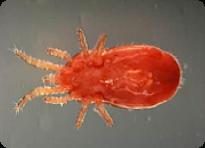
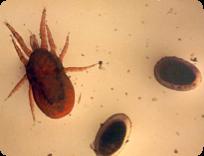
Red Mite The RED POULTRY MITE, Dermanyssus gallinae, is a very prolific external parasite of birds which can be very difficult to eradicate – partly because the mite can survive for up to eight months between feeds – so they are often in situ, just waiting for the arrival of a newflock! Mites feed largely on blood of the birds, but also on feathers, skin or scales ; each blood feed lasts approximately 1-2 hours after which the mite leave the birds and return to hide in cracks and crevices in the poultry housing, where they lay their eggs, returning to the birds again the following night – hence, it is easy to miss their presence if examining a bird during daylight. Heavy mite infestations in chickens lead to high levels of stress and result in anaemia, reduced egg production and, eventually if not treated, death, so the effects of red mite are of considerable economic importance when considering production costs. Additionally, mite can transmit diseases, such as the chicken pox virus, Newcastle Disease, fowl typhoid and salmonella as well as causing dermatitis and mange. When disturbed, they will also bite interfering humans and can cause a type of dermatitis. At one time it was thought that mite only tended to live in wooden structures, but they are now found on both plastic and metal – anywhere that is as near to their next meal as possible. Nowadays, they are also becoming increasingly common in battery cages, where they cause severe health problems and economic loss. The tiny mite vary in appearance, depending on when they last fed – a mite is only red when it has consumed blood recently and changes colour again through black to grey as the interval between feeds increases. When checking housing areas for mite, a tell-tale ‘grey ash’ around crevices is evidence of mite faeces, but the best time to examine a house is at night, when the mite can often be seen with the aid of a torch, both on and off the bird. Red Mite, in common with lice and other arachnids (spider-type creatures with eight legs) have a waxy exoskeleton (hard outer covering), without which they rapidly dry out (desiccate) and die. One of the best methods of attacking Red Mite therefore is to use a strong degreasant compound which dissolves the exoskeleton and rapidly kills the mite by desiccation. This method has the advantage that it is impossible for the mite to build resistance, a growing problem with many pesticides, and means that the same treatment can be applied repeatedly to keep the infestation under control. |
|
Smite is a specially selected, super-strength degreasant, disinfectant cleaner, with excellent wetting properties, which has been proven highly effective at eliminating Red Mite in poultry housing. It is pleasant to use, for both the operator and the birds, is economical and contains no pesticides. |
|
Symptoms of Red Mite Infestation • Pale, ‘jaundiced’ faces and wattles, through anaemia • Depressed birds, lacking vitality • Emaciation – or even weight gain! • Decreased egg production • Increase in feed intake coupled with decreased egg production • Dark dots and speckles on normally plain eggs – they may be blood spots or on closer inspection you may see the speckles move! • In extreme cases, feather loss and signs of dermatitis • Whitish-grey ‘ash’ (mite faeces) around the edges of crevices and in trails along and under perches. • Active red mite on housing which glow in the light of a torch at night. (Underneath the roofing felt is a favourite place for mite to hide!) • Hens may avoid a nesting box which is particularly badly infected. • Never assume that red mite are the problem if you can’t find any physical signs of them at all – remember, most sick hens display some similar symptoms, whatever the cause! • If in doubt – ask your vet. |
|
The Red Mite Life Cycle Mites feed on the bird under cover of darkness each night and return to their crevices during the day • Eggs are laid in crevices in the housing. Eggs are pearly white and oval, approx 0.4mm x 0.25mm. • After 2-3 days, in warm conditions (longer in cooler weather), the eggs hatch into 6-legged larvae. • Within 24 hours, the larvae moult into 8-legged prontonymphs, which start to feed on the roosting birds. • Prontonymphs then moult into deutonymphs, which continue to feed, before moulting again to become adult male or female red mite. • In warm, favourable conditions, this whole life-cycle can be completed within seven to ten days, which means that • Mite populations in poultry housing grow very rapidly during the summer months, but • Gradual climate change and warmer winters means that rather than being a problem which is only encountered during the summer, mite are now continuing to reproduce, though at a slower rate, through the winter, so need increased vigilance to keep populations in check. • Mite can survive for up to eight months without a feed and have been known to lie dormant for ten years! • When hidden in cracks are very resistant to desiccation – so cleaning out and leaving a house empty will not prevent mite reappearing when birds are reintroduced! • Mite can be carried by wild birds and prevailing winds, so can appear even when there has been no previous evidence of infestation. |
|
|
|
Scaly Leg Mite What is it? Scaly leg mite is the third most common parasite to plague chickens and their owners alike! The mites attack the leg scales of the bird by burrowing underneath them and laying eggs. This causes the leg scales to swell significantly which causes discomfort and irritation to the bird. The general condition of the leg scales will deteriorate to become dry and sore. Without fast intervention scaly leg can eventually make the bird lame. It is highly contagious and common with birds kept on bare earth, damp ground or in dry litter runs. Symptoms • Raised, swollen leg scales • White chalky deposits on the legs • Thickened, crusty looking legs • The bird will peck at its legs in an attempt to reduce the pain Prevention The key to preventing scaly leg mite is good management. The area in which the poultry is housed should be disinfected with an appropriate product such as Smite Professional. This will reduce the likelihood of the mites entering the housing and reaching the bird. Equally it is important to remain vigilant and to be aware of the symptoms of scaly mite as it is easier to treat at the early stages. |
|
© PestTrappa 2009. The whole of this document is copyright and is made available for the use of SMITE resellers and their customers. Any reproduction or further publication of this document, in whole or in part, by any means, may be made only with the express permission of PestTrappa and its origin should be acknowledged. Smite and Smite Professional are Trademarks of PestTrappa. Contact: PestTrappa Tel: +44 (01246) 264635 or info@smite-a-mite.com |
All you ever wanted to know about mites!
Click here to download a
PDF version of this information
 |